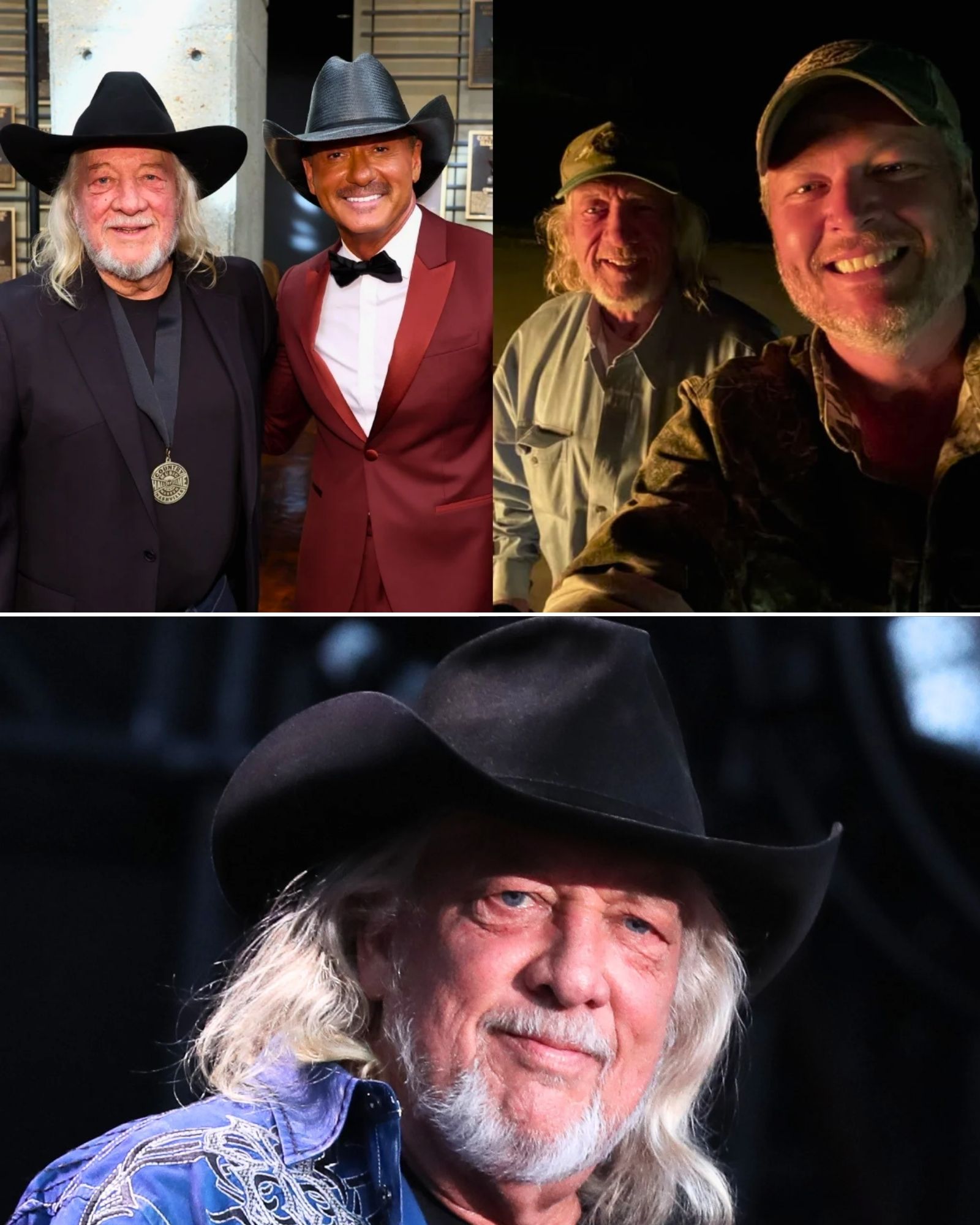
Three days before John Anderson’s death, Tim McGraw shared a moment with John Anderson that would become part of a heartbreaking tribute: conversation, laughter, and a few familiar songs sung together.
The meeting took place on October 18, 2026, during the Country Music Hall of Fame’s Medallion Ceremony in Nashville. Tim McGraw was being inducted that evening. John Anderson, who had received the same honor in 2024, was there to celebrate the new members.
After John Anderson died on October 21 at age 71, Tim McGraw shared a photograph from the evening and described their time together. The detail that stood out was wonderfully ordinary. Two country singers had enjoyed each other’s company and sung songs Tim McGraw loved.
“We talked, we laughed, we sang his songs that I loved so much together, just goofing off.”
Those were Tim McGraw’s words. The memory was specific, personal, and recent enough to explain the shock that followed.
A celebration that became a cherished memory
The October 18 ceremony honored Tim McGraw, Paul Overstreet, and the Stanley Brothers. For Tim McGraw, the occasion marked formal recognition of a career spanning more than three decades. For the established Hall of Fame members attending, the ceremony offered another opportunity to welcome fellow musicians into country music’s highest circle of recognition.
John Anderson had occupied that place for just two years. At the October 20, 2024, induction ceremony, Shawn Camp performed “I Just Came Home to Count the Memories,” the Del McCoury Band performed “Would You Catch a Falling Star,” and Lucinda Williams sang “Wild and Blue.” Bobby Braddock presented John Anderson’s medallion.
Those performances reflected a catalog that reached well beyond a single hit. John Anderson’s recordings had given other singers, musicians, and listeners decades of reasons to pay attention.
By October 2026, John Anderson was attending another class’s celebration. Tim McGraw’s account preserves a small part of that evening that an official list of speeches and performances could never fully capture: the pleasure of singing familiar songs with the person who made them famous.
The songs were still bringing people together
John Anderson’s place in country music rested on an immediately recognizable voice. Influenced by singers including Merle Haggard and George Jones, John Anderson developed a delivery that remained distinct through the commercial peaks of the early 1980s and the career resurgence of the 1990s.
Listeners knew the records. Tim McGraw’s recollection added something more intimate to that history. The songs remained part of a living conversation between artists, available to sing together even during an evening devoted to formal honors.
After the death announcement, Tim McGraw described being “completely shook.” The closeness of the dates gives that reaction its context. Sunday’s encounter had included laughter and singing. By Wednesday, John Anderson was gone.
Tim McGraw did not identify which songs the pair sang in the account shared publicly. There is no need to supply a title or turn the encounter into a documented final performance. What Tim McGraw actually remembered is enough.
On one of the most significant evenings of Tim McGraw’s career, John Anderson was present. The two country singers talked, laughed, and shared music.
Three days later, that simple memory became something Tim McGraw could offer alongside the grief: a picture of John Anderson enjoying the songs that had already meant so much to so many people.